

Before-and-after imagery is a dynamic way for small businesses to illustrate the real impact their products and services make. However, this approach can’t be an afterthought. It must be baked into the plan from the beginning.
Engage the senses and imagination by vibrantly illustrating the excellence of your business.
By Roy Harryman
For better or worse, we’re a visual culture. Images and video can make or break your business.
It’s not just tweens, teens and young adults who are drawn to YouTube, Instagram and other visually-oriented social media. It’s every demographic.
In addition, nearly all social networks have become increasingly visual. Consumers pay shocking amounts for phones, in part, because of their sophisticated camera features.
But images don’t stop at social media. Traditional advertising, websites and email marketing should be built around pictures and design.
The New York Times used to be nicknamed “the old Gray Lady.” Columns and columns of text co-existed with a spare number of black-and-white photos. It wasn’t until 1993 that color appeared in the paper. Now, in addition to having a hard time finding a newspaper, it’s hard to find one without color.
Make no mistake: Words are still essential and always will be. And the more expensive the product (say a $150,000 metal fabrication machine vs. a $150 handbag), the more words are needed.
The bottom line: Consumers demand we show and tell.

Before-and-after marketing is effective in demonstrating the benefits of roof tile soft washing.
Tell me something I don’t know
Yes, you’ve noticed we live in a visual culture. But when it comes to marketing, you must embrace it. I didn’t say you have to like it. But you must incorporate it into your approach.
It’s likely you’re already doing this to some degree. But having photos and videos is not the same as having good photos and videos.
“Having photos and videos is not the same as having good photos and videos. ”
Every image should have a business objective. It needs to exist for a reason. And it needs to reflect the excellence of your brand.
In the past, a photographer was defined as someone with expensive equipment and an elite set of skills. The democratization and digitalization of media has turned anyone with a cell phone into a photographer. But that doesn’t mean their end product is useful.
Business owners may have a never-ending supply of photos of kids, grandkids, pets and vacations. But when it comes to business, the cupboard is often empty or contains only a few spoiled crusts. That means it’s time to start taking photos. Or to have someone do it for you. Here’s Business Photography 101 to get you started.
What to avoid:
Low-resolution, pixelated photos
Blurry photos
Photos with too much light (overexposed) or too much darkness (shadows)
Photos without a clear subject. Yes, that’s a nice picture of a large room, but what is the eye supposed to be drawn to? A picture of everything is a picture of nothing.
Staff photos that look like police mugshots
Stock photography (whether purchased or pirated) of customers and workers who are actually not your customers and workers
What to strive for:
High-resolution, clear photos without visible pixels (dots and grain)
Photos with sufficient lighting to highlight the subject
Photos with a clear subject. The viewer’s eye should be drawn to a particular part of the image.
Staff photos that feature employees in front of an inviting backdrop, smiling and with a consistent level of quality
Pictures of real products and services, featuring real employees and real customers
Why not stock photos?
Capturing quality photos and video – and doing it consistently – takes work. Which is why it’s rarely done. When confronted with a need for photos, many immediately turn to stock photography. Stock photos are images available for purchase from large media corporations or individuals.
Just because an image exists on the internet does not mean it’s available for commercial (or even personal) use. You must gain the consent of the image owner. If you don’t, you may face legal action. This is what makes stock photos convenient: Paying for them gives you a license to use them.
However …
I recommend using these sparingly. The fault of these images is that they are too perfect. Examples:
Women smiling and laughing at salad (who does this?)
Telemarketers with perfect teeth and glowing smiles who walked right out of a modeling agency and into a call center
People at an office meeting having the time of their lives
Every mom, child and dad looks like a model (because they really are!)
Consumers are intelligent. They know these aren’t your customers and employees. They know you phoned it in and settled for artificial sweetener instead of the real deal.
The demand of today’s consumers is increasingly toward authenticity. Show your personality. Show you’re human. Show it’s OK not to be a model (unless you are one). Just smile. Do your job. People are interested in people, not slick, manufactured corporate avatars.
The other kick in the pants with stock images is there’s nothing to stop anyone from buying and using the same image you did. You and a competitor could both end up with the same fake telemarketer picture! The remedy: Take your own photos or hire someone to do it.

Show real people doing real work: Wayne West of Hydra Corp. Photo by Roy Harryman
Video rules
The magic of video is that it offers a three-dimensional perspective that tugs at our senses and emotions. But for that to work, video has to be excellent. This doesn’t mean it must be shot by a professional. But however you capture video, it must incorporate a few practices of professionals. You can get by without an extraordinarily expensive camera. Many high-quality, high-definition videos have been recorded on cell phones. The ultimate arbiter of what recording device you use will be your intention. If the video will mostly be viewed on mobile phones, ultra-high resolution is not necessary. If it will be shown on a 10-foot-tall screen, then you’ll need to ensure you’re capturing video with a great amount of detail.
Tips and tricks for better videos:
Hold the camera still. Shaky video is impossible to watch, makes people literally sick and ruins your message. For stability, set the phone/camera down while it records or place it on a tripod. You can also use software to stabilize a shaky video after it’s recorded (but this has its limits).
Let light work for you, not against you. It may seem creative to sit an interview subject in front of a window with the sun in the background. Don’t do it. If the light is behind the subject, she will be in the dark. Always put the light in front of the person or image you’re filming.
Choose a background free of distractions so that the object of your photo doesn’t have to complete with anything else.
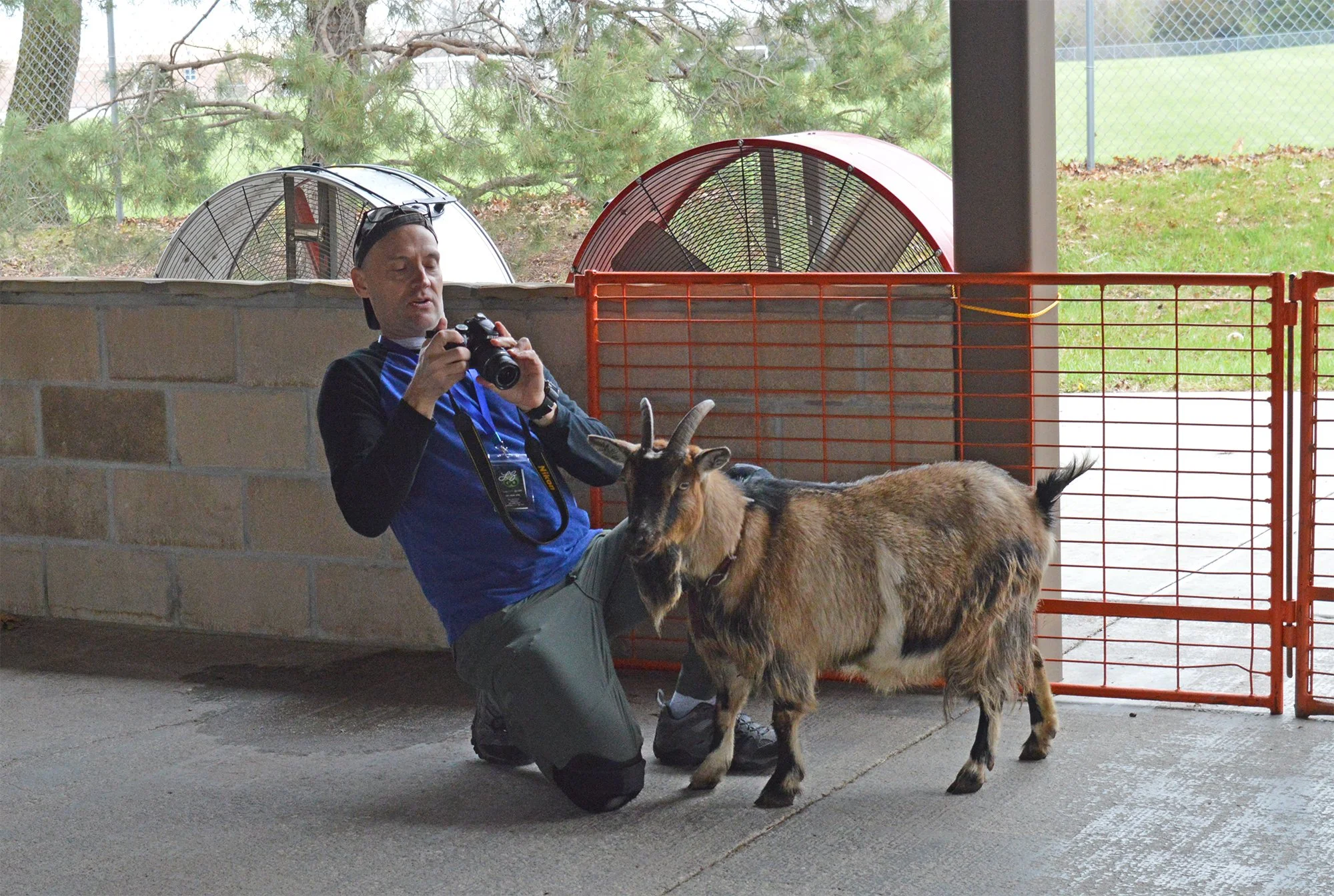
Getting a photo of a surly participant at a goat yoga class. Really!
Mind the audio
According to Steve Stockman, author of “How to Shoot Video That Doesn’t Stuck,” research demonstrates people will endure shaky, poorly lit video, but draw the line at audio. If the consumer needs to hear the audio, and it’s terrible, she’ll bail.
Capturing quality audio is not an easy thing. In fact, it takes planning. Background noises, such as a commercial refrigerator or bugs chirping in unison, can destroy your audio. Guess how I know this? Even distant ambient sounds, such as a highway, can invade a quiet space. Choose your location carefully and test the audio quality before you commit.
Second, you should always attach a microphone to your interview subject. This can be a wired or wireless mic. Don’t use the built-in microphone on your phone or camera. It will sound like you’re filming in a garage.
Many different types of microphones will work. The key is to minimize space between your subject’s mouth and the microphone: The closer the better. And have a backup plan. It’s always wise to have two sources of audio in case one fails.
In addition, some people watch videos with the sound off (usually via phone). If understanding words is critical to the success of the video, you’ll need subtitles.
Be an archivist
Once you invest time or money in quality photos and videos, take good care of them. They can serve you for years to come – unless you pay no attention to where they end up. Strategically name photos and videos and carefully preserve them so you can locate them later. Otherwise, it’s a needle-in-a-haystack search every time you need a piece of media. Finally, back up your photos and videos. Your hard drive will crash and die. If it’s the only home of valuable marketing materials, you’ll need a funeral ceremony for all the work you lost.
Images for impact
Sharing quality videos and photos sets you apart. But it can also result in helping people find your business on the web. YouTube, Vimeo and other video hosts provide ample opportunity for text descriptions and tags that allow people to discover your videos and therefore your business. Flickr and other photo hosting sites (including your website) do the same thing.
In other words, if people search for “Cotton Candy in Carlisle, Illinois” and your cotton candy images are uploaded and labeled, search engines are likely to find them – and you.
One last thing
Although there is no law prohibiting you from taking photos of customers and employees, your safest bet is to have them sign a waiver. You are seeking to make money from the use of their image. For that, you need their consent to have a strong legal standing in the unlikely event you are sued. You don’t have to pay them. You just need their written consent.
Of course, anyone can sue you for anything in the good ole’ USA. But we are still a nation of laws. So be on the right side.
Get your phone out and … go!
There you have it. You live in a visual culture. Grab that mobile device and get started. Photograph your storefront, the store dog, the warehouse cat, forklifts, customers, receptionists employees and customers. And use it all to tell your story.
And remember: Show and tell; don’t merely sell.

Roy Harryman is the author of “Small Business, Big Impact: A No-Nonsense Marketing Strategy For Companies That Do More With Less.” This column is an excerpt from the book.